Outsourcing 3D modeling is commonly involved as projects grow in scope. In content-heavy and live-service titles, internal teams can’t always produce all required assets fast enough. This is particularly true for game environment art, where large volumes of props, modular kits, and set dressing are needed.
Game studios rely on game art partners in the long run, so the goal is not just to find a vendor, but to build a reliable and repeatable production pipeline that integrates external work.
This guide covers the full process from decision-making to quality assurance.
When to Outsource 3D Modeling of Game Assets
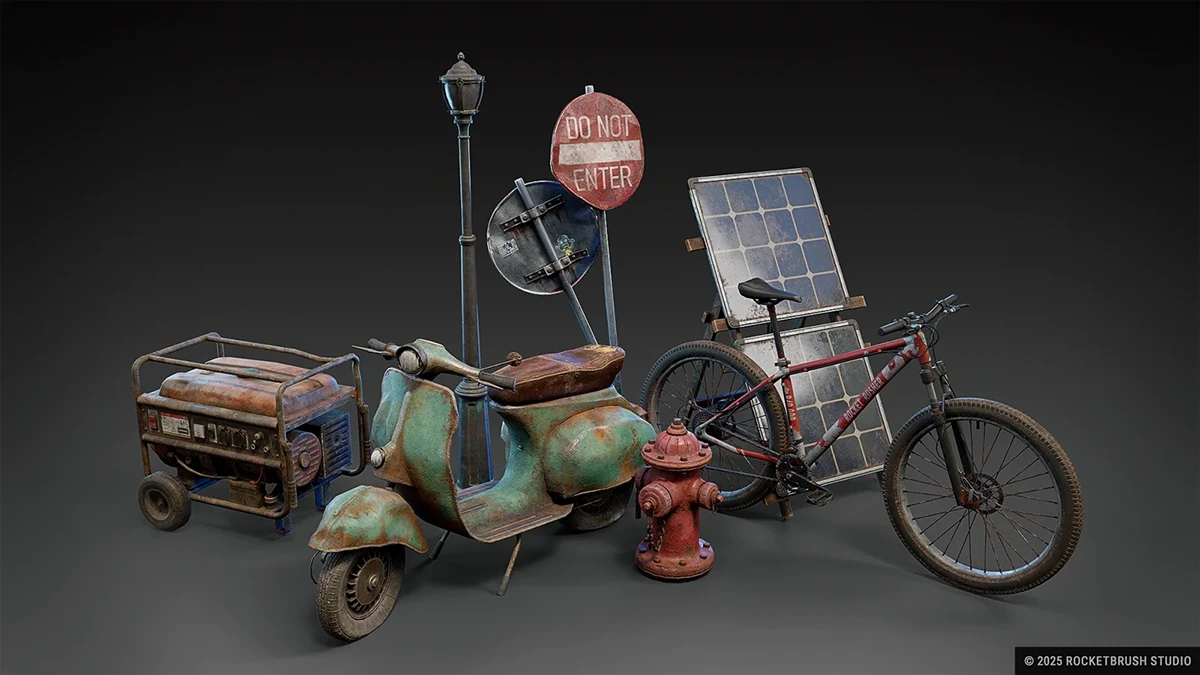
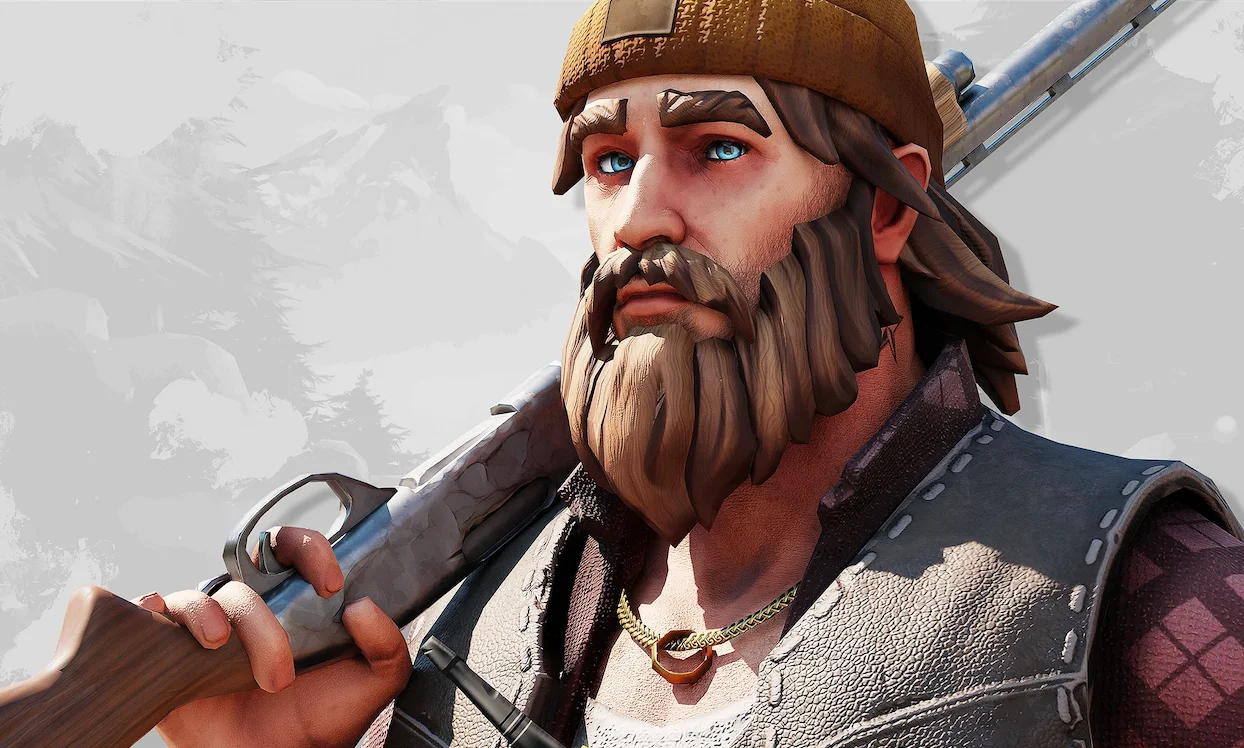
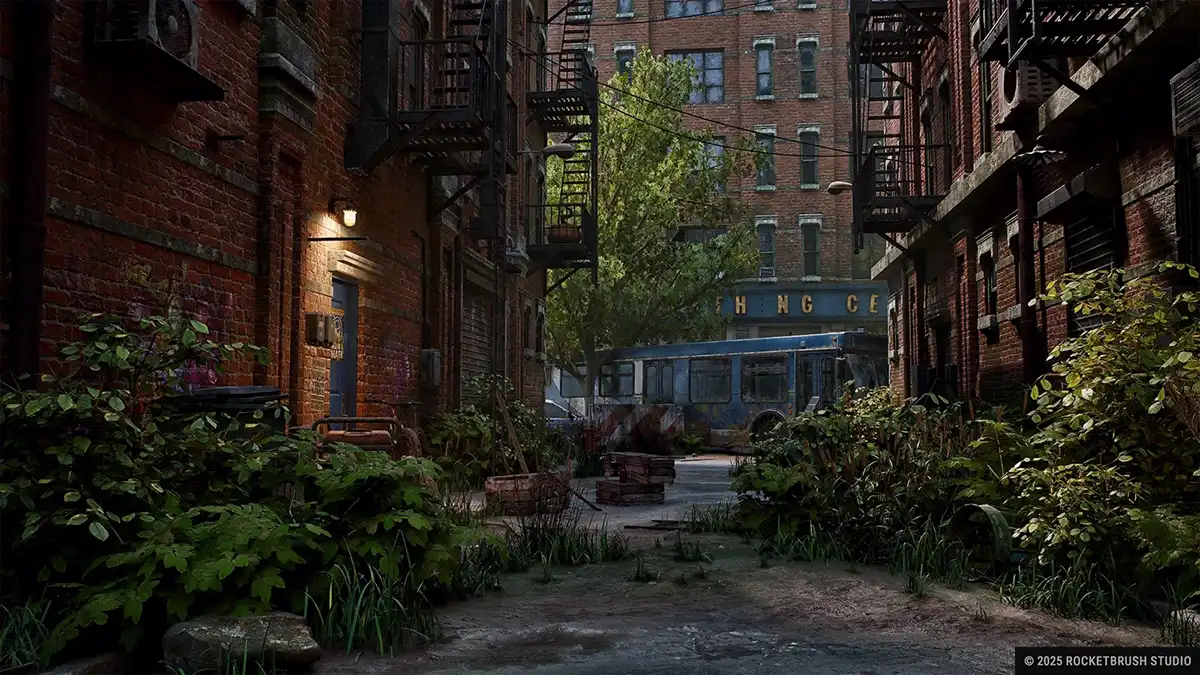
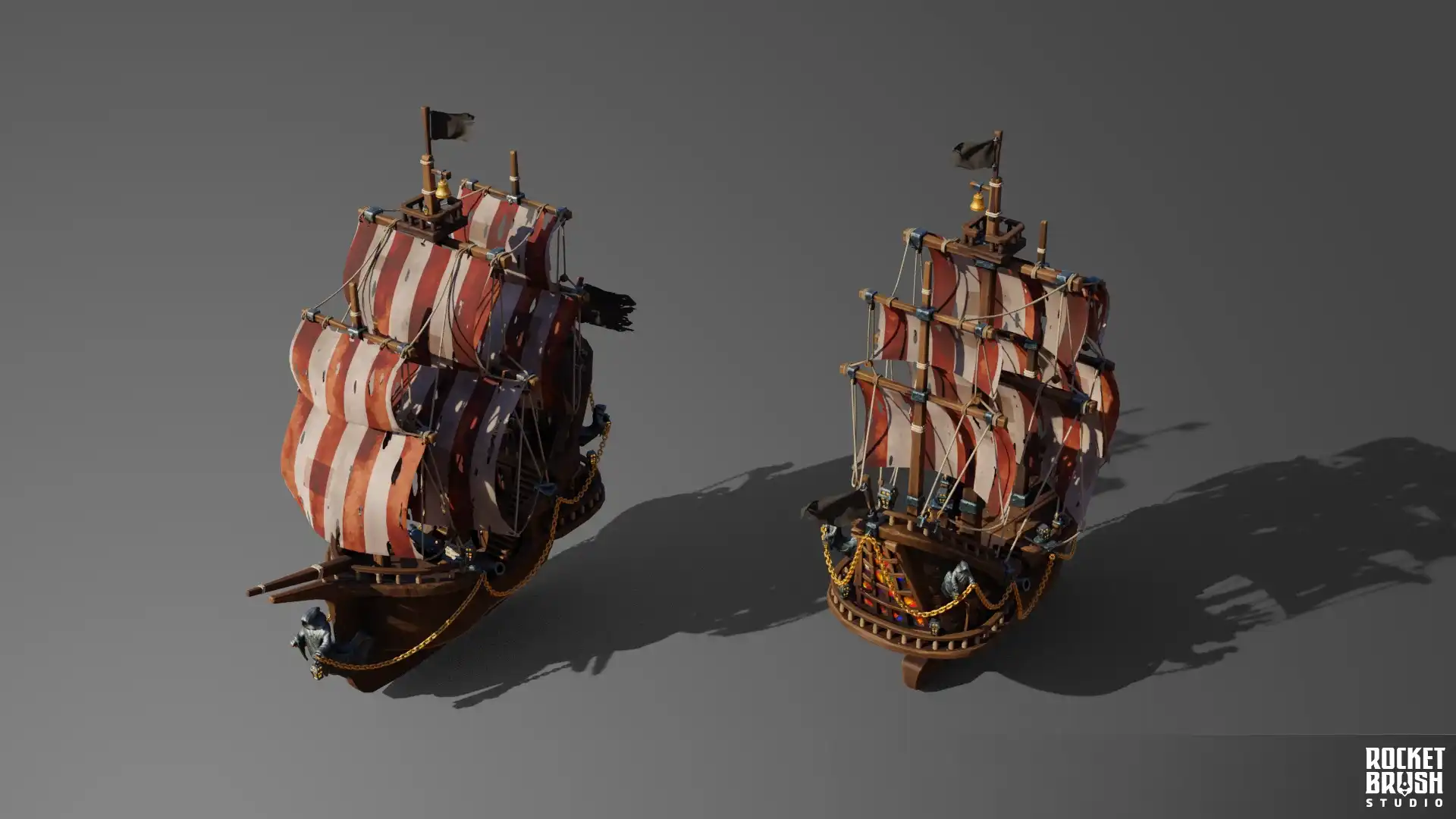
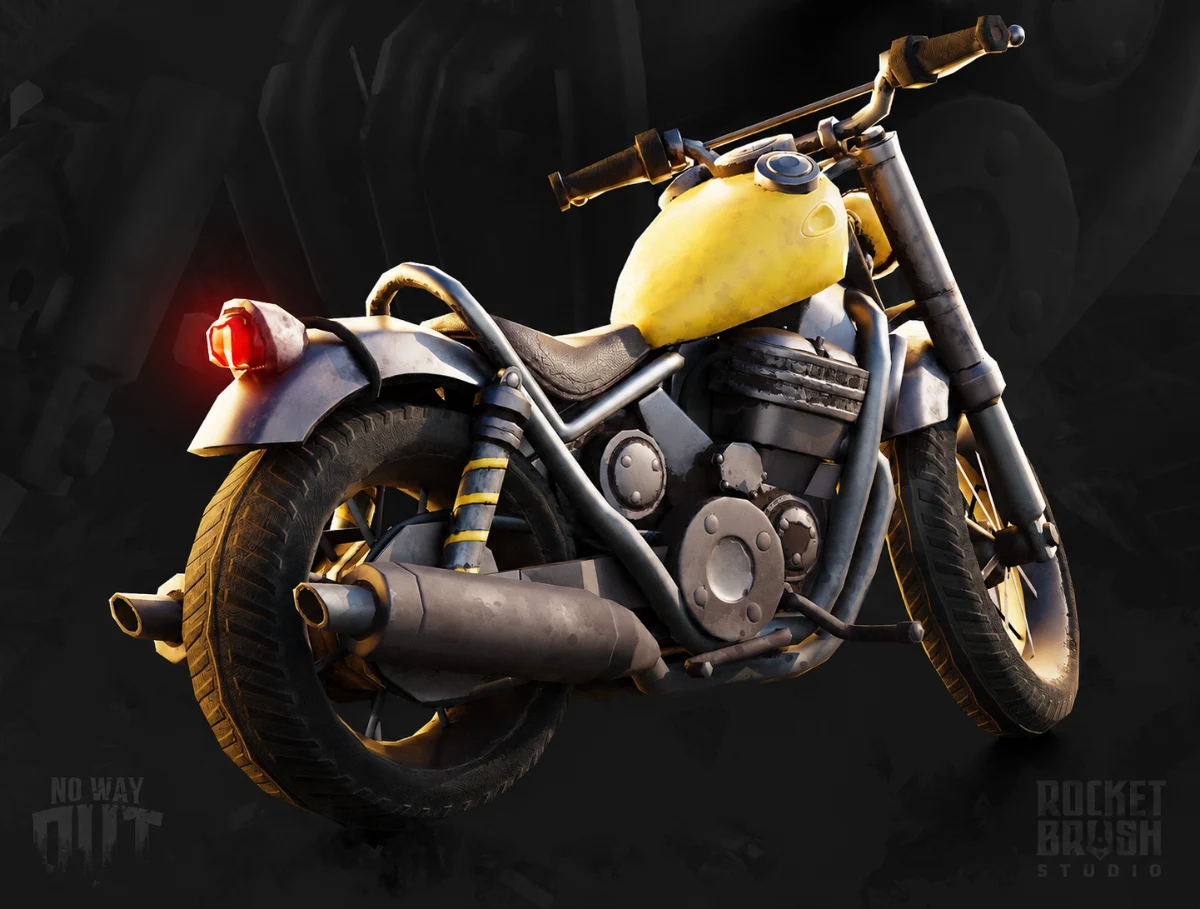
3D environment assets designed by the team at RocketBrush
3D modeling outsourcing is a common practice, but it works best in certain production situations:
Scaling production for content-heavy games
Supporting live-service pipelines with constant asset demand
Filling gaps in specialization (characters, hard surface, environments)
Meeting tight deadlines or milestone pressure
For example, teams working on 3D video games often outsource prop production or modular kits while focusing internally on hero assets and art direction.
When NOT to outsource
Modeling is a middle stage in game production. It comes after the general visual direction is decided and creates a foundation for later stages. Still, outsourcing doesn’t always bring expected results. It can fail if the groundwork isn’t ready:
Core visual identity is still undefined
No clear art direction or supervision
No internal pipeline to review and integrate assets
This is especially risky in early concept art stages, where visual decisions are still evolving. It’s imperative to consider them. Many 3D studios offer additional services, aside from modeling. You can learn what they are and how these studios work from our dedicated article:
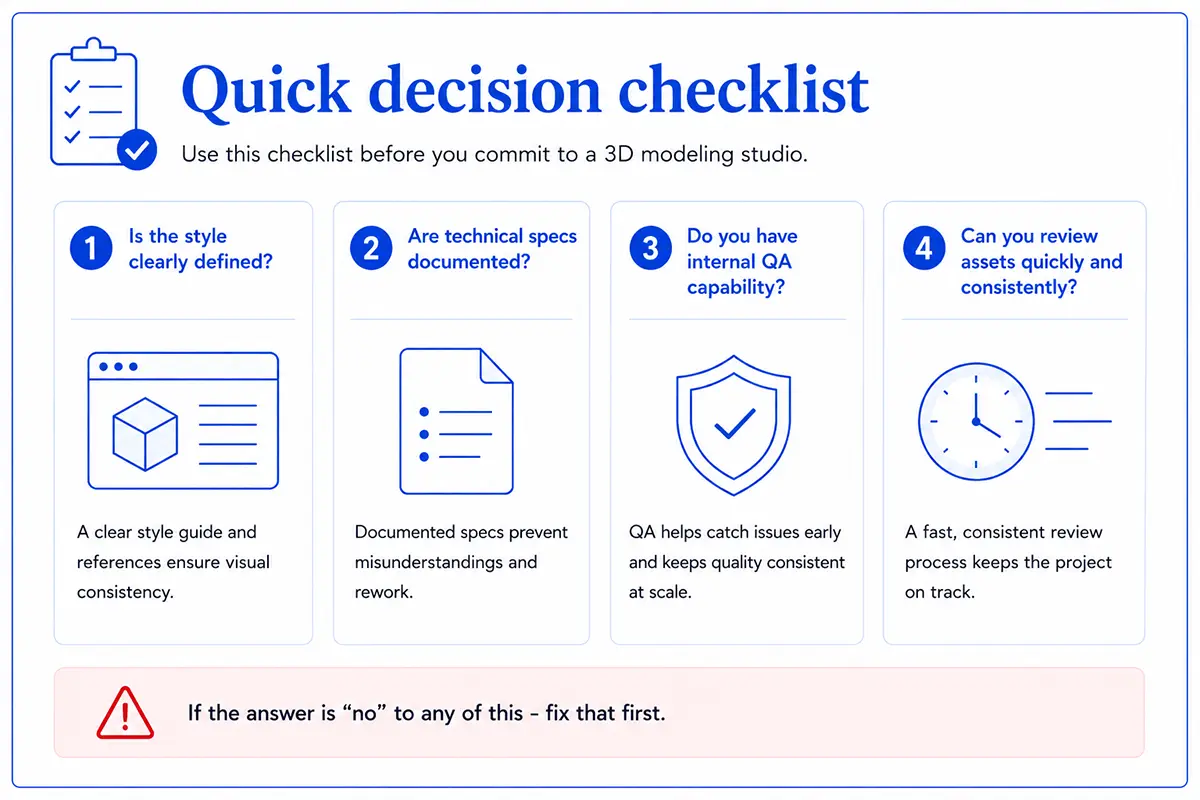
During the early stages of production, it’s important to make clear decisions about both the direction of the project and the pipelines you’re planning to implement. Here is a checklist to help you assess the scope of work.
A checklist of the main production decisions to be made before outsourcing.
3D Modeling Outsourcing Pros & Cons
Outsourcing works best when it is treated as a production tool, not just a way to move tasks outside the team. Before bringing in a vendor, it is important to understand both the benefits and the trade-offs of external 3D modeling production.
Advantages:
Faster asset production at scale. External 3D artists can produce high volumes of models (props, environment pieces, modular kits) fast, which helps when building large game worlds or filling content-heavy pipelines.
Access to specialized 3D skill sets. Outsourcing brings opportunity to tap into artists focused on specific areas like hard-surface modeling, organic sculpting, stylized assets, or AAA-quality characters without long hiring cycles.
Flexible production costs per asset. Instead of maintaining a full in-house team, you can scale spending based on asset batches, which is useful for fluctuating production phases.
Better scalability for smaller asset and weapon production. Especially effective when items like weapons, gear sets, and props can be split into batches and produced in parallel across multiple artists or vendors.
Pipeline acceleration for high-volume work. When the modeling pipeline is well-defined (blockout → high poly → low poly → UVs → bake → texture), outsourcing allows multiple asset streams to run simultaneously.
Risks:
Communication gaps and unclear briefs may lead to iteration delays and rework, especially during retopology and baking stages.
Lack of strict technical standards can result in inconsistencies in topology, scale, and texel density when assets are combined.
Misalignment with engine requirements may require additional cleanup for LODs, collision meshes, or material setups.
Integration challenges can appear when assets that look correct in isolation need adjustments for lighting, shading, or performance in-engine.
Slower feedback cycles may reduce iteration speed compared to in-house teams, particularly when revisions depend on scheduled updates.
Outsourcing is often used as a production multiplier. It doesn’t remove pipeline responsibility, but it can make production faster, more flexible, and easier to scale when the process is well prepared. Most risks on this list are manageable if the team defines clear requirements, sets up review stages, and works with a reliable 3D art outsourcing studio.
If you are looking for 3D assets for a project, reach out to us at RocketBrush Studio, and we’ll help you define the most appropriate pipeline.
[[cta:Need game art for your next project?:Tell us about your game, and we’ll assemble a production-ready art team with a pipeline tailored to your style, platforms and deadlines.]]
How to Prepare for Ouгtsourcing in 5 Steps
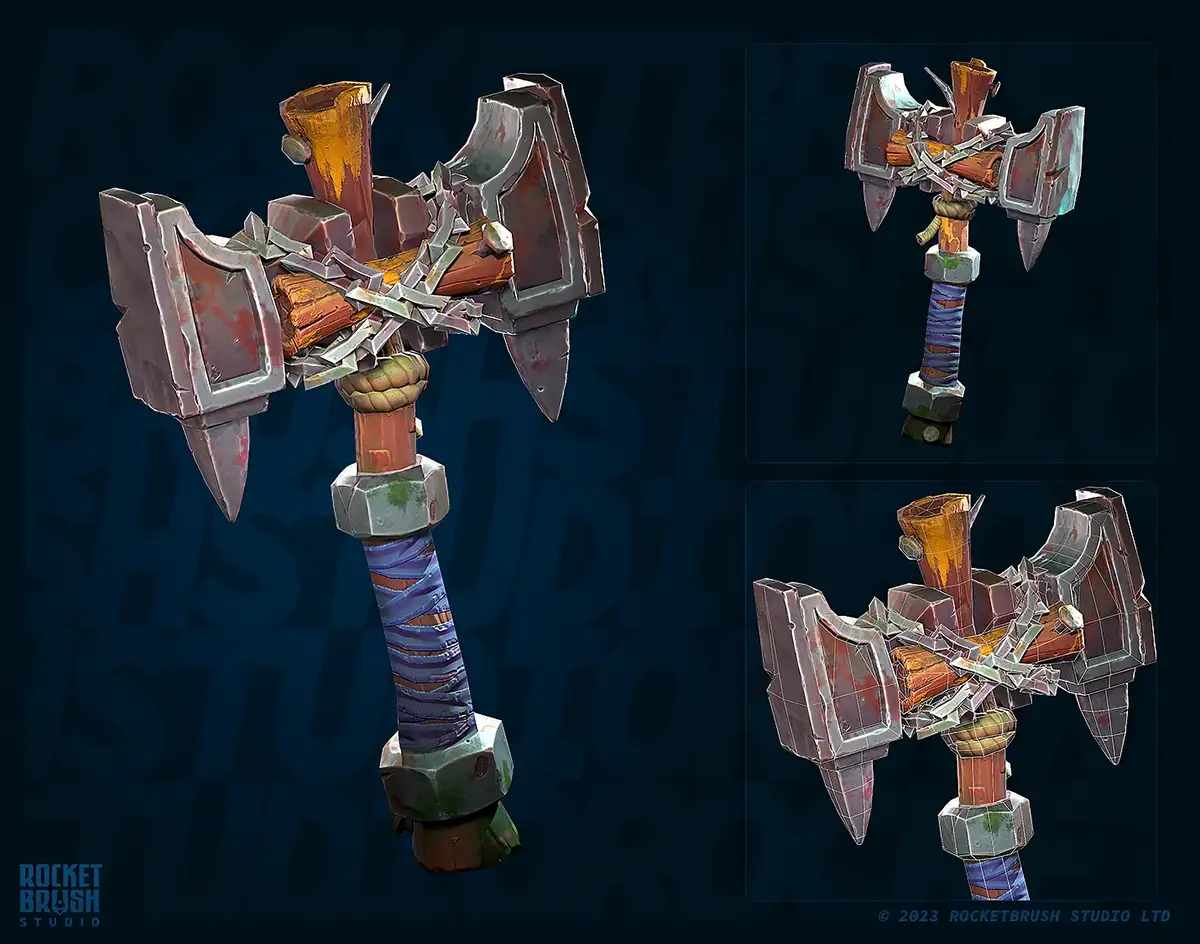
3D stylized weapon model designed by artists at RocketBrush Studio.
In outsourcing, preparation is often what determines success. When inputs are unclear, results may fall short of expectations. This 3d modeling outsourcing checklist breaks down the key steps to take before engaging with a vendor.
1. Asset Definition Checklist
Prepare a full asset list that includes the scope of work, quantities, and priorities. Make sure that asset categories such as characters, props, and weapons are clearly defined. It’s best to also include expected LODs per asset.
This often includes modular kits, props, decals, and set dressing assets.
2. Visual Direction
It’s important to include clear style references: games, concept art, or moodboards. Depending on your expectations (just 3D modeling of characters and props, or full circle development from concepts to game-ready assets) add clear do’s and don’ts and a defined quality bar.
Strong concept art is critical here — it reduces ambiguity and iteration.
3. Technical Requirements
One of the most important steps is to ensure that the vendor knows the target platform (mobile, PC, console). The platform would determine texture resolution and texel density. There are engine requirements (Unity, Unreal) that have to be considered. Last but not least, clearly communicate your polycount budgets.
Requirements differ significantly between 2D and 3D assets, so clarity is essential. This step is often discussed with the external team to make sure their expertise is acknowledged.
4. File & Pipeline Requirements
You have to be clear on the file formats you expect to receive (FBX, OBJ), as well as naming conventions and even folder structure. It also helps to define version control expectations.
5. Optimization Guidelines
For streamlining the later stages of collaboration with the vendor, determine LOD setup rules and texture packing. Draw call expectations and specify the existing performance constraints. This is especially important for 3D modeling in scenarios where asset count directly impacts performance.
What to Check Before Choosing a 3D Modeling Vendor
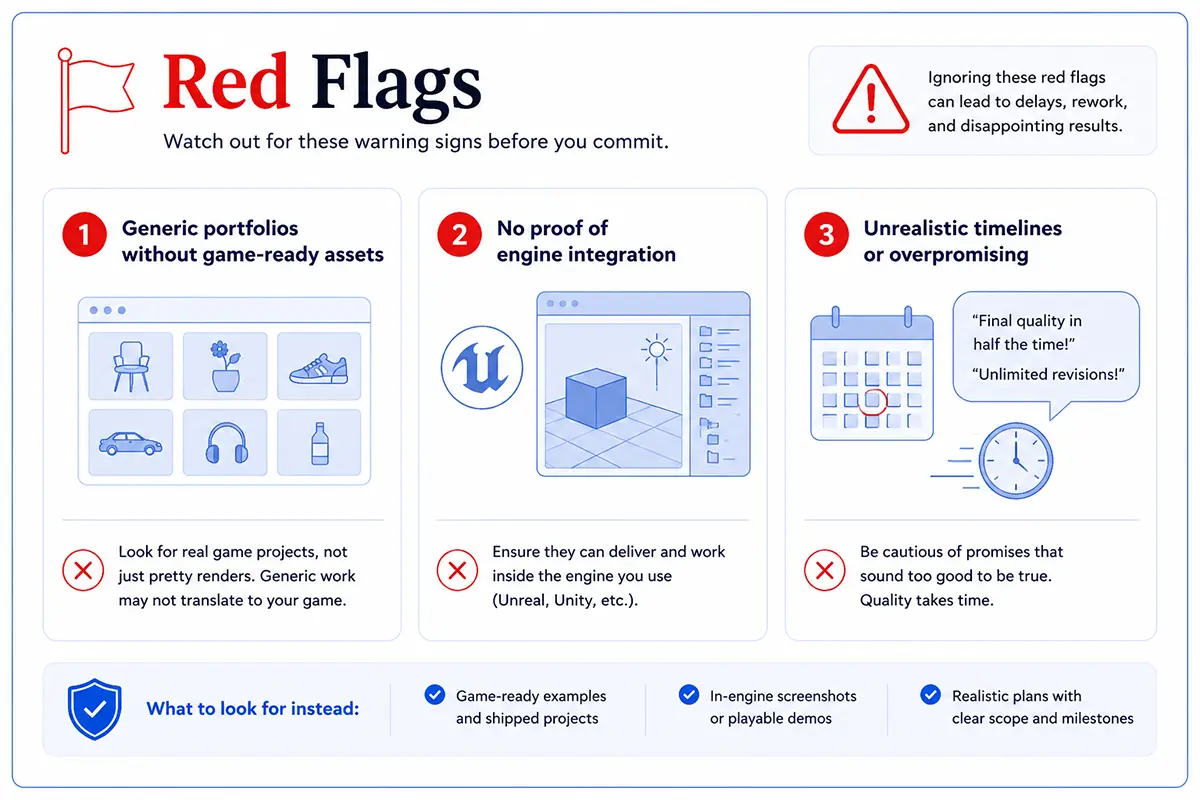
Red flags to consider while selecting a studio to collaborate with.
The most important thing to remember while assessing the vendor for 3D modeling is to look beyond visual quality. It’s an important factor, but it’s not the only thing to consider. Additionally, review:
Relevant experience. Look for work that matches your project type—real-time assets, specific genres, or platforms. A strong portfolio is only useful if the vendor has solved problems similar to yours.
Production capacity. Assess whether the team can handle your workload and scale if needed. A small team may deliver quality but struggle with deadlines if the scope increases.
Pipeline maturity. Check how structured and repeatable their workflow is—naming conventions, version control, QA steps, and engine integration. A mature pipeline reduces errors and rework.
Communication and responsiveness. Evaluate how clearly and quickly they respond during early discussions. Delays or vague answers at this stage often translate into production bottlenecks later.
For 3D model outsourcing, the type of assets is crucial. If you’re looking for character modeling, a vendor experienced in character design pipelines would be far more valuable than a generalist studio.
How to Review a 3D Modeling Portfolio
When assessing a portfolio, start by checking relevance — look for work that matches your game’s genre, visual style, asset type, and platform constraints, since strong stylized work doesn’t always translate to realistic pipelines.
Then evaluate technical quality, including clean topology with proper edge flow, efficient UV layouts, consistent PBR textures, and well-optimized LODs that preserve silhouettes.
It’s also important to confirm engine readiness, such as correct scale, properly set pivots, and materials that import cleanly into your target engine.
Finally, pay attention to production quality signals like consistent naming, organized files, and uniform quality across assets, as these reflect how reliable the vendor will be in a real pipeline.
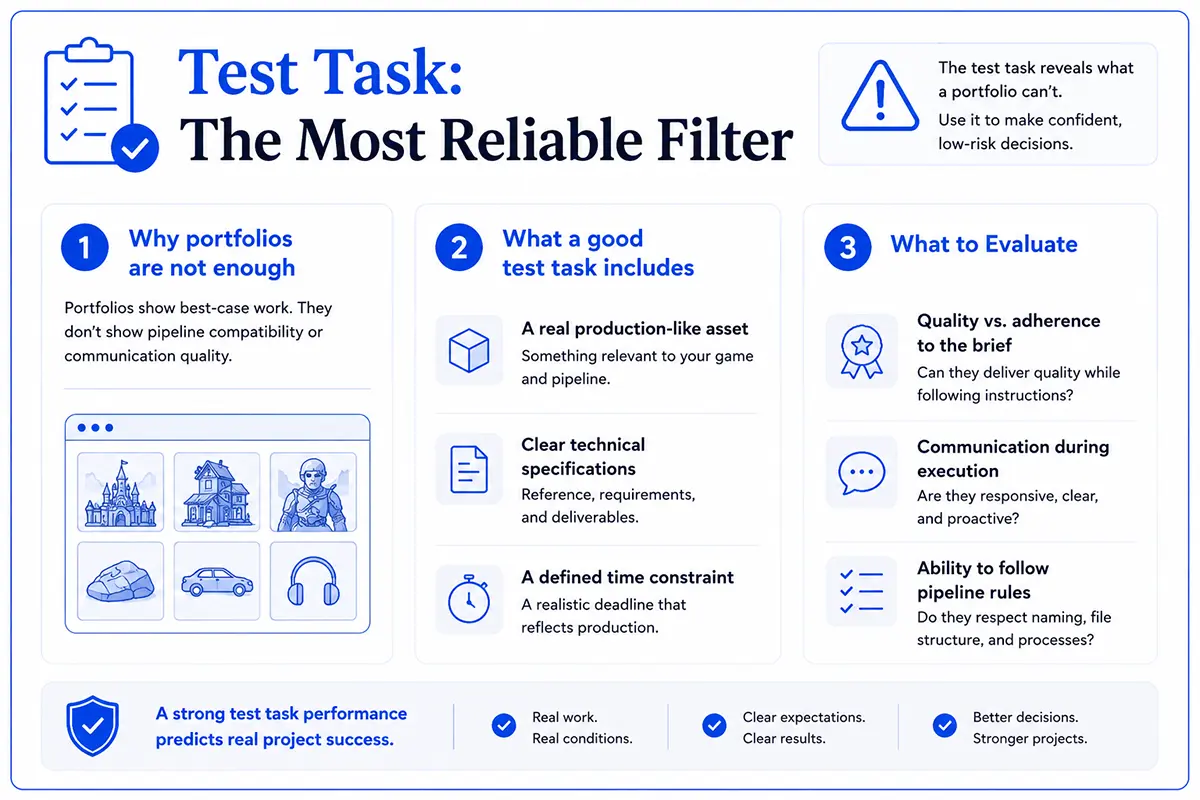
A cheat sheet for preparing and evaluating a test task.
Common Outsourcing Mistakes
To make sure your collaboration with the vendor goes smoothly, it’s important to avoid common issues that often disrupt 3D modeling pipelines and lead to mismatched expectations.
Vague or incomplete briefs – lack of clear references, style guides, or technical specs leads to assets that don’t match expectations and require rework.
Choosing vendors based on price alone – low cost can come at the expense of consistency, pipeline compatibility, or long-term reliability in production.
Ignoring technical validation – skipping checks like topology, UV layout, and engine readiness often results in assets that fail during integration.
No internal QA process – without structured review stages, issues accumulate across assets instead of being caught early.
Skipping test tasks – without a small pilot task, it’s harder to verify quality, workflow compatibility, and communication before full production.
Poor communication structure – unclear feedback loops and scattered communication slow down iterations and create avoidable misunderstandings.
Many of these issues directly impact pipelines, where consistency and scale play a key role.
FAQ
When should I outsource 3D modeling?
When production demand exceeds internal capacity or requires specialized skills. This is typically the point where internal teams can no longer maintain speed without sacrificing quality or burning out. Outsourcing becomes a way to stabilize throughput while keeping the core team focus on direction and key assets.
What is the biggest risk in outsourcing?
Lack of clear direction and technical requirements. Without precise documentation, vendors are forced to interpret expectations, which leads to inconsistent outputs and rework. This often creates bottlenecks during integration, especially in engine-ready pipelines where small technical mismatches matter.
How do I ensure consistent quality?
Define a strong visual direction, enforce QA, and use test tasks. Consistency depends on having clear standards that are applied before and during production, not just at final review. Regular feedback loops and structured validation checkpoints help prevent issues from accumulating across batches.
Is outsourcing suitable for early-stage projects?
No. It works best after the style and pipeline are clearly defined. Early-stage projects usually involve changing direction, which makes external production unstable and inefficient. Once the visual language and technical framework are locked, outsourcing becomes significantly more predictable and effective.
How detailed should a 3D modeling brief be for outsourcing?
A 3D modeling brief should include clear asset lists, visual references, technical constraints, and engine requirements. The more precise the brief (polycount, texel density, naming rules, LOD expectations), the fewer iterations and misunderstandings will occur during production.
What should be included in a test task for a vendor?
A test task should replicate real production conditions on a small scale. It should include a representative asset, full technical requirements (UVs, topology, textures), and clear evaluation criteria so you can assess quality, communication, and pipeline compatibility before scaling production.
How do you measure if an outsourcing pipeline is working well?
A healthy outsourcing pipeline is measured by consistency, not just visual quality. Key indicators include low rework rates, predictable delivery times, correct engine-ready assets on first submission, and minimal manual fixes needed during integration.
Key Takeaway
Outsourcing 3D modeling succeeds when preparation, evaluation, and QA are treated as a system.
Strong pipelines and clear expectations matter more than individual talent. This is especially true for ongoing projects, where production scale amplifies small issues.
A structured approach reduces risk, cost, and delays—and turns outsourcing into a long-term production advantage.
What to Keep in Mind:
The best vendor is often the most reliable, with a possibility of long-term collaboration
Clarity at the start prevents rework later
Always validate under real production conditions
Treat outsourcing as an extension of your team
If your project needs quality 3D modeling that fits in seamlessly with your existing pipeline, reach out to our team at RocketBrush.
Create with us
Contact us, and we'll craft the perfect game art for your project