menu
Close

GET IN TOUCH
Check what other game developers say about working with RocketBrush Studio:

BLOG
In 2026, many publishers are revisiting classic IP relying on an existing fanbase, lower commercial risk, and modern platforms that can extend a game’s lifecycle. In these conditions, the line between remaster and remake may feel blurry.
A remaster upgrades the original game’s visuals and performance while keeping its core gameplay and structure intact. A remake, on the other hand, rebuilds the game from the ground up, often on a new engine and adds updated mechanics, redesigned assets, and sometimes changes to the story or level design.
This guide breaks down what a remaster really is, what defines a remake, and where related terms like reboot and port fit in. The goal is practical clarity: what changes, what doesn’t, and how to tell the difference from a production standpoint.
The simplest way to settle the remaster vs remake debate is to compare what each of them changes. The main differences come down to scope, technical changes, production time, and target audience:
A remaster focuses on upgrading visuals and performance, while a remake involves rebuilding the game from scratch. As a result, remasters are faster and more cost-effective to produce, while remakes require larger budgets and longer development cycles. Remasters mainly target existing fans, whereas remakes aim to attract both returning players and a new audience. That distinction is useful as a rule of thumb, but marketing labels and gaming media don’t always reflect the actual scope of work.
A remaster can include noticeable gameplay tweaks, while a remake may stay surprisingly faithful to the original. For studios planning production, this affects expectations around scope, budget, and what actually needs to be rebuilt.
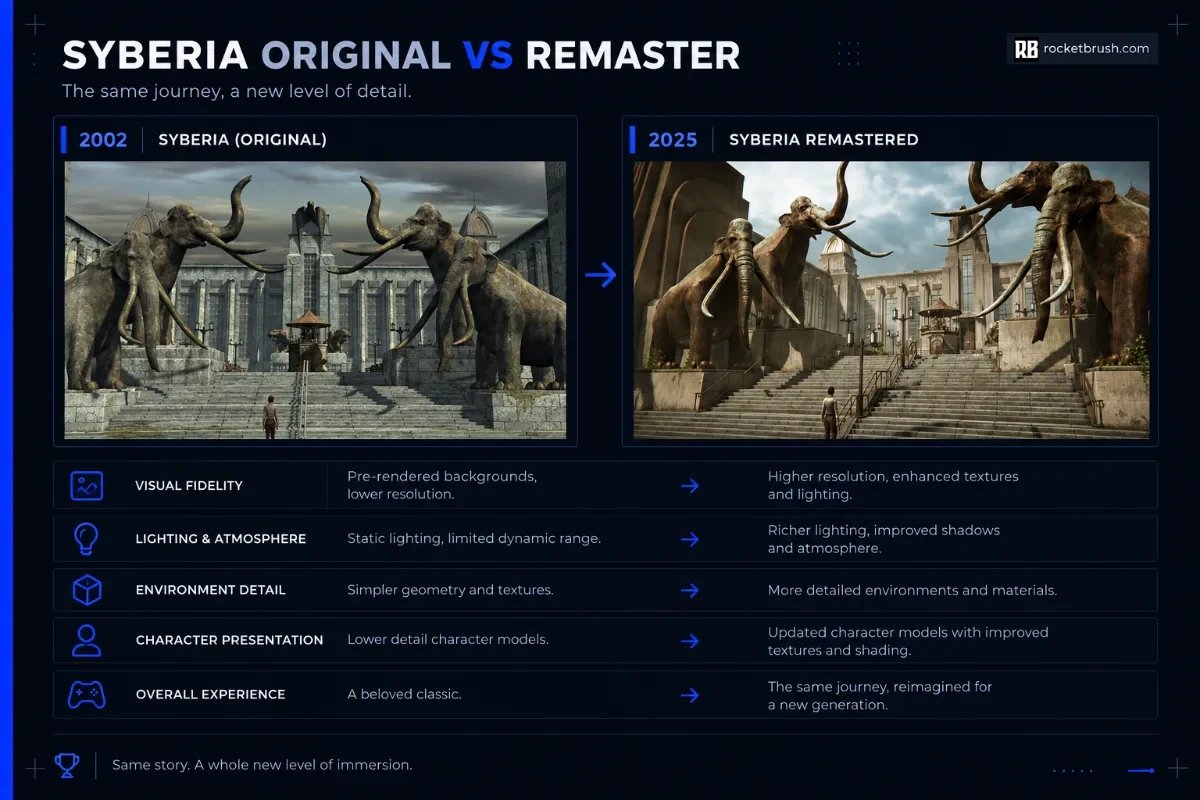
A video game remaster is an upgraded version of an existing game that improves its technical presentation without fundamentally changing how it plays. A remaster typically preserves the core game and focuses on how the game looks and sounds on modern devices.
Developers boost resolution, add higher-fidelity textures, stabilize or increase frame rates, remix audio and music, and occasionally update the user interface or control scheme to match modern expectations.
The intent is to let longtime fans revisit a title they already love and give new players an easier entry point, all while preserving the experience the original developers intended, just without the rough edges that come from aging hardware and outdated display technology. To make the line between "same" and "upgraded" concrete, here's a breakdown of exactly what a remaster tends to leave alone and what it tends to change:
Remasters focus on preservation with polish — making the game feel modern without altering its identity.
[[cta:Need game art for a remake or a remaster?:Tell us about the original game, and we'll assemble a production-ready art team with a pipeline tailored to your style, platforms and deadlines.]]
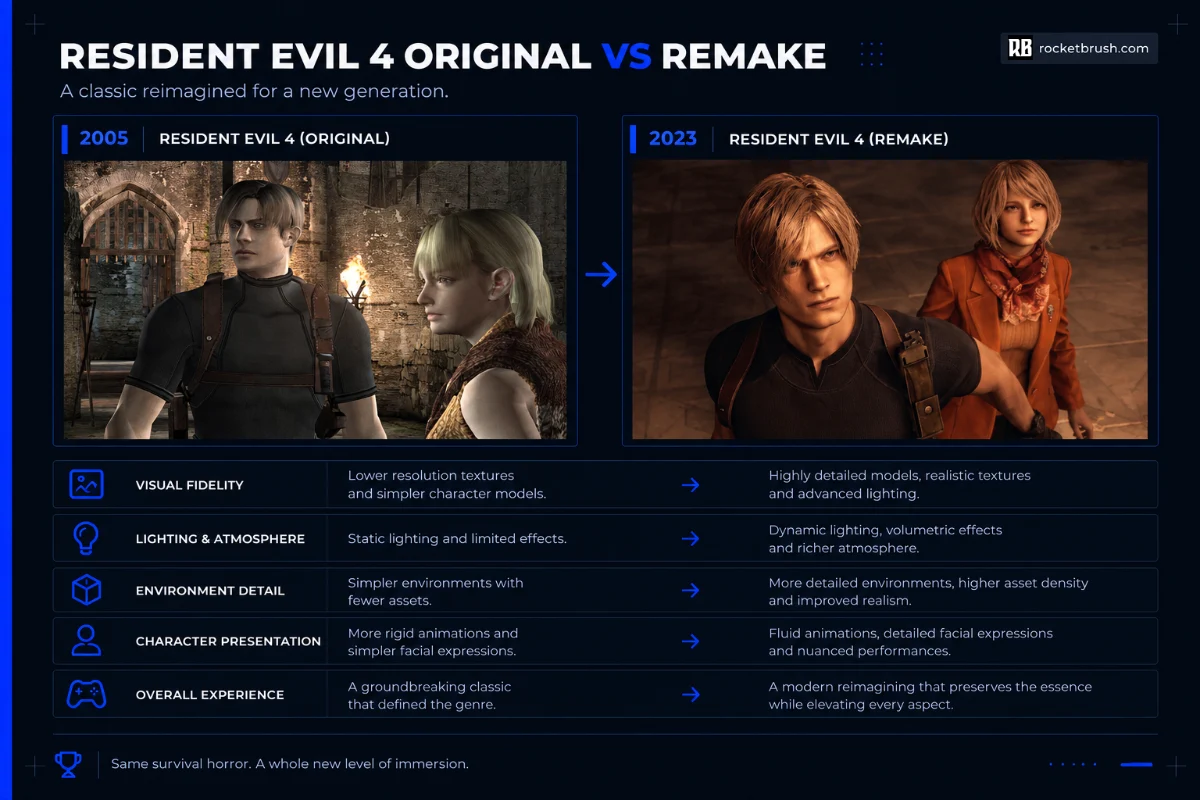
A video game remake is a full reconstruction of the original game, usually built from scratch on a new engine. Unlike a remaster, a remake treats the original as a blueprint rather than a fixed foundation.
Typically, developers redesign or replace character models and environments, rebuild levels using modern engine technology, rewrite core systems like combat, physics, or AI, and re-record voice work and music from the ground up.
A remake can touch nearly every layer of the game, including gameplay mechanics, pacing, difficulty, and sometimes even story details.
The intent is usually to reimagine a title for current hardware and design sensibilities, expanding or modernizing the experience while still honoring the characters, world, and narrative core that made the original memorable. To make the line between "rebuilt" and "reinterpreted" concrete, here's a breakdown of exactly what a remake tends to change and what it tends keep:
A remake may aim for fidelity — or reinterpretation. Either way, it’s closer to rebuilding than upgrading.
Both remakes and remasters often include new art, be it promo images or ,in case of remakes, new character design. For a list of the top 2D art outsourcing studios, check out our article.
[[ref:top-studios-2d-game-art-outsourcing-character-design]]
Let’s look at a few recent examples to see how remasters and remakes differ in practice.
Original: 2006 · Remastered: 2025
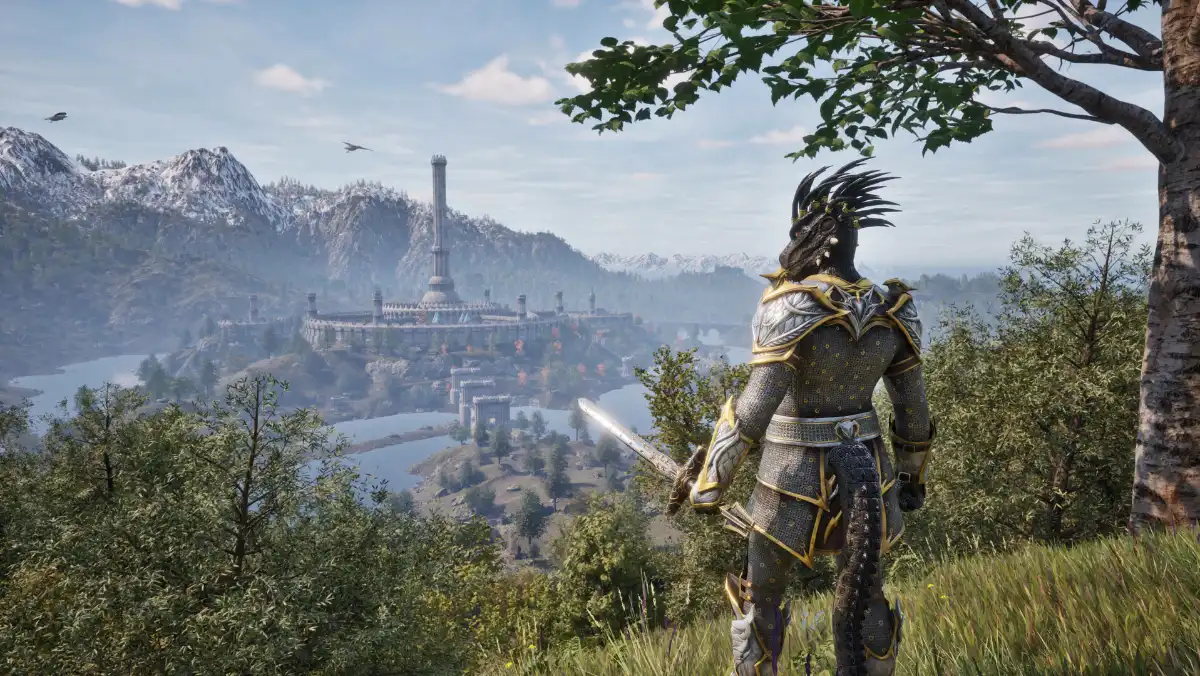
Bethesda and co-developer Virtuos rebuilt the game in Unreal Engine 5, added 4K resolution with ray tracing, upgraded lighting, and rebuilt models for nearly every character, spell, and item in the game.
Bethesda explicitly framed the project as a remaster rather than a remake. As the studio explained when the game launched:
“We never wanted to remake it – but remaster it – where the original game was there as you remember playing it, but seen through today’s technology.” — Bethesda Game Studios
That philosophy explains why Oblivion Remastered can substantially rebuild its visual presentation while preserving the original game underneath.
Beyond the visual overhaul, the team made only modest systemic tweaks — a new sprint option, a redesigned interface, adjusted enemy scaling, and reworked camera angles — while leaving the leveling system, quests, and story essentially untouched.
The reception has been enthusiastic: the game drew huge concurrent player counts at launch and crossed nine million players within three months.
Original: 2001 · Remake: 2024
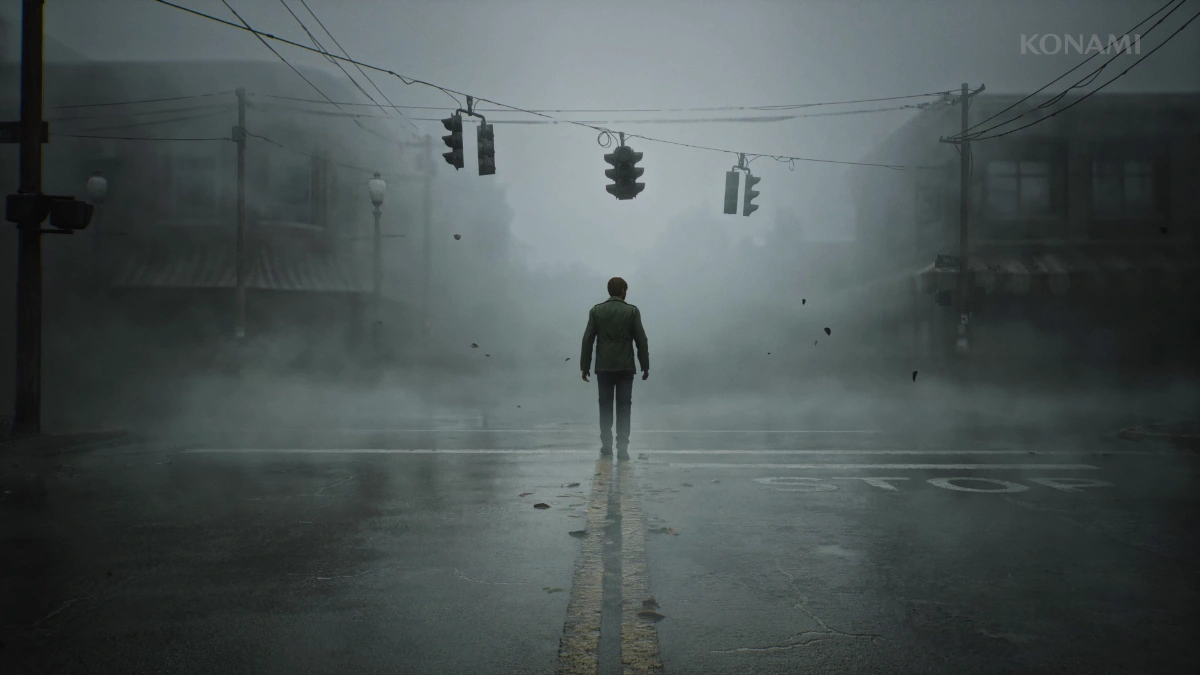
Bloober Team rebuilt this 2001 classic essentially from the ground up for its October 2024 release, overhauling the combat into a more responsive over-the-shoulder system, fine-tuning puzzle design, and layering in next-gen lighting and atmospheric sound design.
The remake also replaces fixed camera angles with a fully dynamic perspective, reworks level layouts to feel more cohesive and explorable, and expands character performances through updated motion capture and voice acting. Narrative pacing has been adjusted with additional scenes and environmental storytelling, while UI and controls have been modernized to align with contemporary survival horror standards.
While early gameplay trailers drew sharp backlash, with players criticizing stiff animations and unconvincing weapon impacts, sentiment flipped dramatically once the game launched. It received a 91% critic recommendation score on OpenCritic and an 87 Metascore. A large share of player reviews praised how faithfully it preserved James Sunderland's story while modernizing everything around it.
Original: 1996 – 1998 · Remastered: 2024
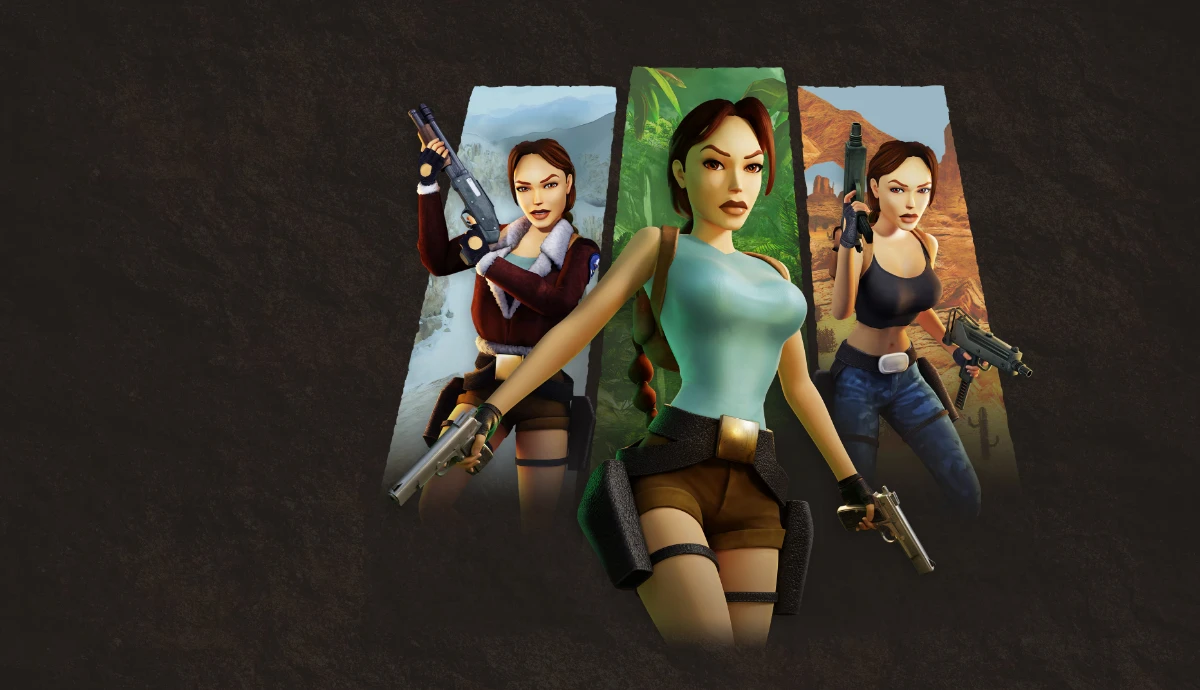
Aspyr's February 2024 collection bundles the original PS1-era trilogy with upgraded textures, lighting, and character models, plus a toggle that lets players flip instantly between the classic and updated look. Gameplay itself was left almost entirely alone — the puzzles, exploration, and even quirky original touches like locking the butler in the Croft Manor freezer are all still there.
The collection also modernizes controls with an optional scheme alongside the original tank controls, smooths out camera behavior, and adds quality-of-life updates like improved saving and UI readability. Level design, enemy placement, and progression remain faithful to the originals, but the presentation layer has been reworked to make navigation and platforming feel less dated.
That hands-off approach split opinion: longtime fans largely embraced it as a nostalgic, respectful trip back to Lara Croft's earliest adventures, while other reviewers and newer players found the deliberately unmodernized controls and dated mechanics a tougher sell.
Original: 2008 · Remake: 2023
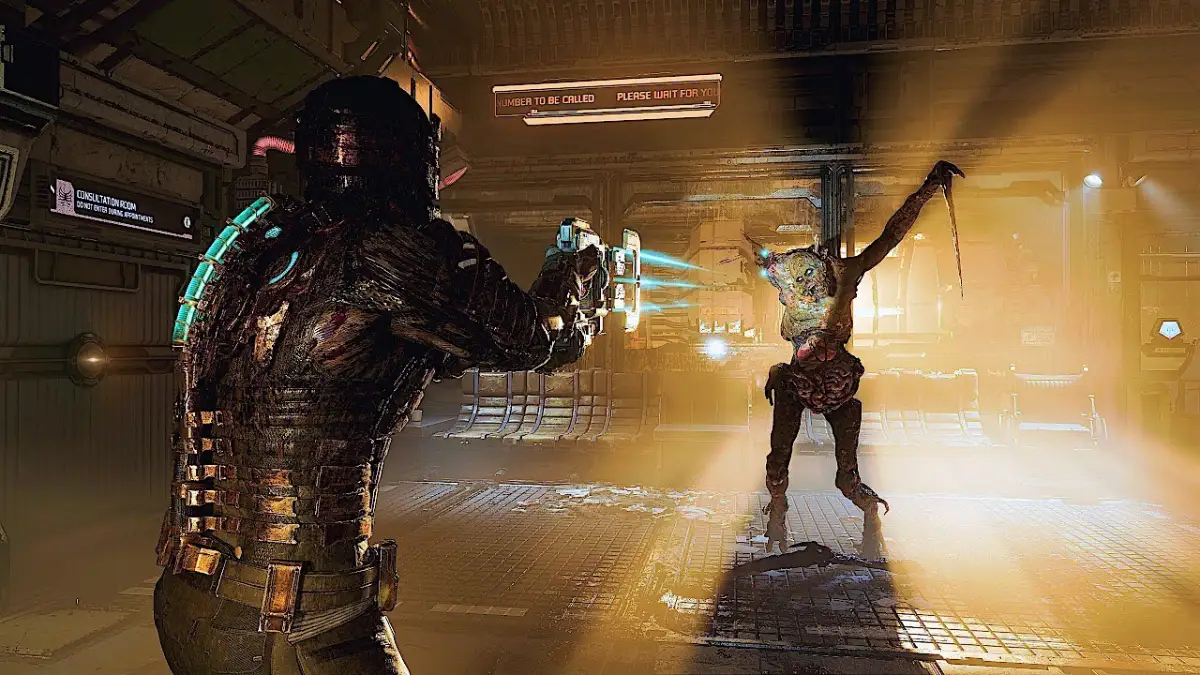
Motive Studio rebuilt Dead Space in EA's Frostbite engine, reconstructing the USG Ishimura as one seamless, loading-screen-free ship and giving protagonist Isaac Clarke a voice and dialogue for the first time. The remake also expanded the narrative itself, adding side quests and deeper lore for supporting characters alongside a security-clearance system that rewards backtracking through earlier areas.
Combat and zero-gravity traversal were reworked to feel more fluid and precise, while enemy AI and encounter design were adjusted to maintain tension even for returning players. On the presentation side, the game introduces an intensity director that dynamically shifts lighting, audio, and enemy spawns, keeping familiar sections unpredictable. UI elements were refined into a fully diegetic system, preserving immersion while improving readability.
Reception was near-universally positive, with critics calling it one of the best remakes ever made for deepening the original's story and horror without losing what made it work. But, while most players welcomed the fuller characterization, some purists missed the original's silent protagonist and felt that the rewritten dialogue shifted the tone.
These examples show the spectrum — from preservation-first remasters to reinterpretation-heavy remakes. But more importantly, they reflect the reception from fans and new players, and present a scope of what they are prepared to see changed.
Dead Space remake required recreating familiar creatures and characters with the new technology. Check out our list of top 3D modeling studios that can help you with remaking an outdated game.
[[ref:top-studios-3d-character-modeling-game-art-services]]
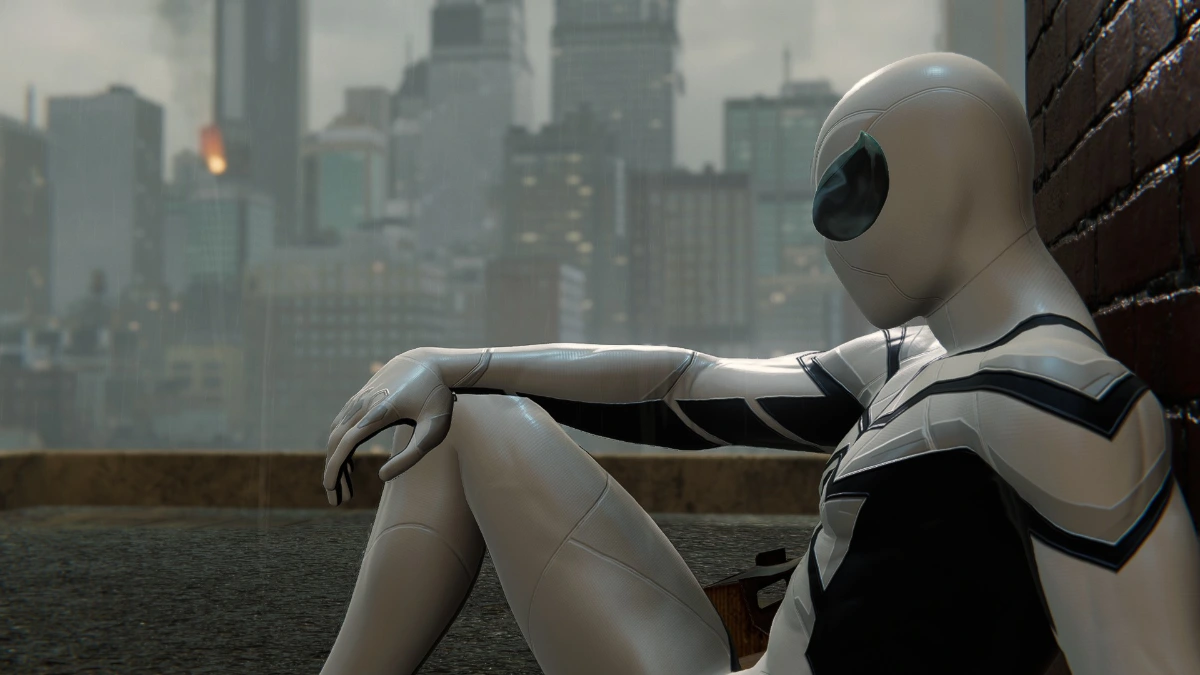
Aside from remasters and remakes, games can also be rebooted or ported, and the definition matters, especially since a reboot is often mistaken for a remake, and a port can be part of a remaster.
Reboots are common when a franchise feels outdated or creatively exhausted but still has strong brand recognition. Tomb Raider was a reboot that reimagined Lara Croft’s origin with a more grounded, cinematic approach. From a production standpoint, reboots function like entirely new IP built on familiar foundations.
Ports are common when bringing titles from console to PC, or from older hardware to modern systems. For example, The Witcher 3: Wild Hunt Complete Edition brought the game to new hardware with performance improvements, though it sits somewhere between a port and a light remaster.
When trying to revitalize a franchise, studios often turn to these options. Each approach can help maintain an existing fan base and encourage new players to try a beloved title. The choice depends on a mix of production and market factors:
In practice, this is less a question of terminology and more related to ROI versus creative intent. Studios occasionally face criticism for “obvious cash grabs” if the updated content doesn’t bring anything new or the new take on a game feels too different from the original. Most players and critics would likely agree that the important part is to preserve the spirit of the original as much as possible.
From a production standpoint, the difference is about constraints vs interpretation. In remasters, the goal is consistency — updating assets without breaking the original visual language. In remakes, the work shifts toward redefining style rules and building scalable pipelines for new assets. At RocketBrush, that means translating legacy art direction into production-ready guidelines, whether we’re enhancing existing assets or rebuilding them for modern engines. – Art Director at RocketBrush Studio
Remasters and remakes serve different roles in bringing older games to modern audiences:
The distinction matters not just for players, but for studios making decisions about scope, cost, and creative direction. Alongside these, reboots and ports offer alternative ways to revive or extend a game’s lifecycle, each with its own production logic.
Ultimately, the right approach to remaster vs remake, depends on balancing nostalgia with modernization — and delivering an experience that feels relevant without losing what made the original work.
If your project involves updating or rebuilding game art, our team can help with the production side.