menu
Close

GET IN TOUCH
Check what other game developers say about working with RocketBrush Studio:

BLOG
Genre is a business decision in game development – it affects audience fit, production scope, monetization and marketing. In this article, we break down the most popular video game genres in 2025–2026, with revenue statistics and practical notes for PC, console and mobile teams.
Video game genres don’t perform the same way everywhere. A genre that leads on PC can be mid-tier on console or mobile because spending habits and player behavior differ by platform. That’s why we compare the top video game genres by revenue and use game genre popularity statistics to show how demand shifts across platforms.
Use the genre quick links below and the platform revenue charts to guide 2026 decisions – what to build, where to launch and how to scope content.
1. Shooter (attention down)
2. Adventure (long-tail friendly)
3. RPG (long-tail friendly)
4. Strategy (PC long-tail opportunity)
5. Sports (less annual)
6. Puzzle (mobile staple)
7. Racing (polish-driven)
8. Fighting (retention-first)
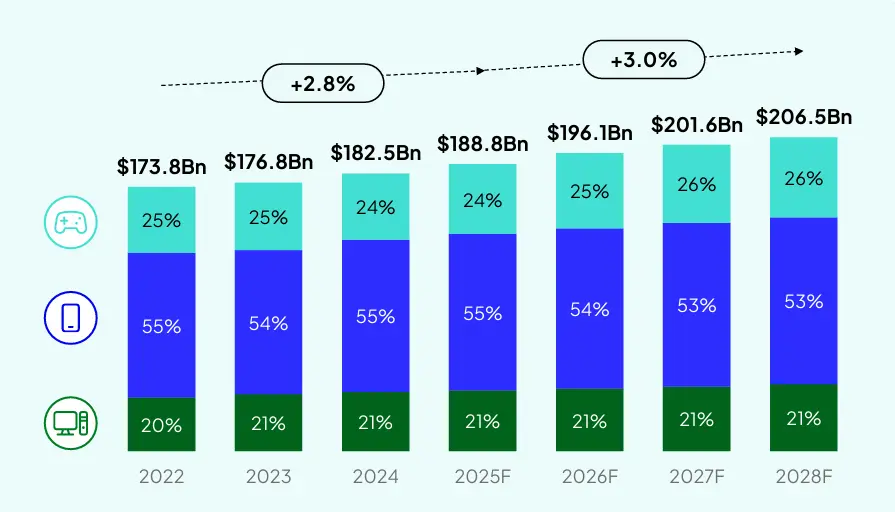
At the start of 2026, it's useful to look back at previous years and the most popular video game genre statistics to understand current trends. So, firstly, let’s explore the market view on the major gaming platforms, according to Newzoo’s Global Games Market Report 2025.
In Newzoo’s forecast, the global games market is expected to reach $196Bn in 2026 and continue growing through 2027–2028. Mobile remains the biggest slice of revenue, followed by consoles, while PC accounts for about 21%.
To see how platform preferences differ in practice, the next chart looks at new titles released in 2025 and shows where their players concentrated across Steam, PlayStation and Xbox. It’s a quick way to understand why the same genre can feel bigger on one platform than another.
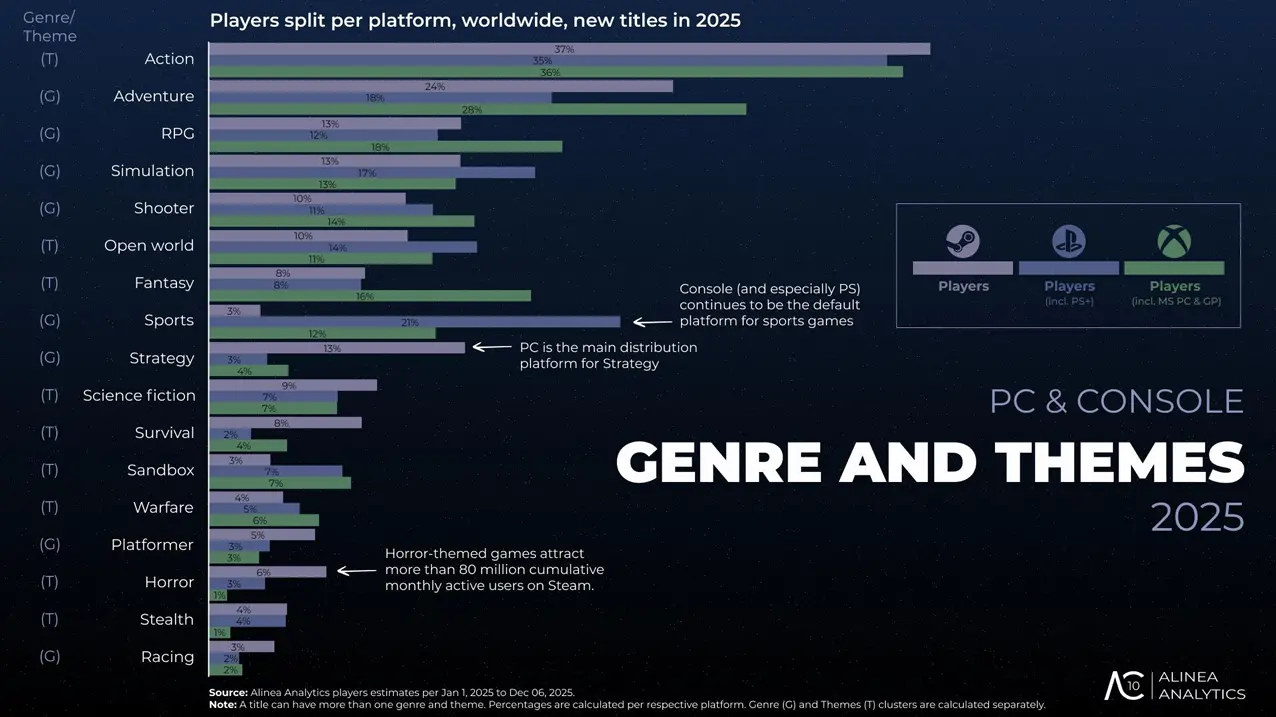
This is why platform context matters: some genres naturally skew toward a specific ecosystem, so a genre that looks strong in a global view can still underperform if you pick the wrong primary platform. Next, we break down the top genres by revenue for PC, console and mobile, and turn each view into practical notes for 2026.
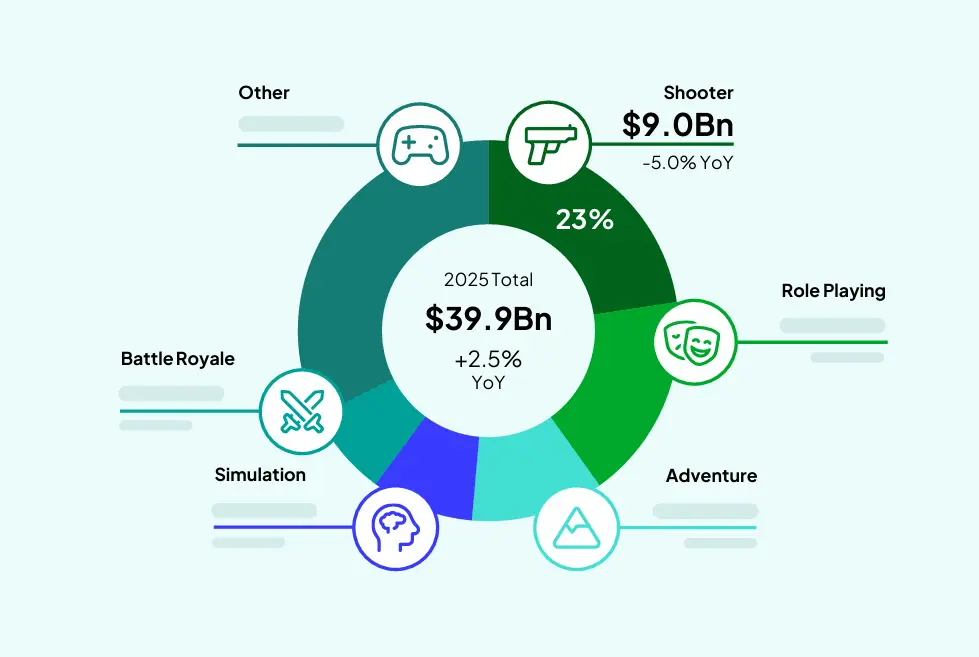
Shooter is still the biggest PC category by revenue in Newzoo’s 2025 split, with total PC spending shown at $39.9Bn. But the attention picture is tighter. Newzoo’s 2026 report describes overall PC and console playtime in 2025 as broadly stable, with PC growing while consoles dipped, so genres are fighting harder for the same hours.
In that context, Shooter and Battle Royale lose share while Sandbox grows, which signals reallocation rather than simple playtime growth. For developers in 2026, the takeaway is clear: shooter remains one of the most popular game genres on PC by revenue, but results depend on a strong angle inside the category and a retention plan, not the label itself.
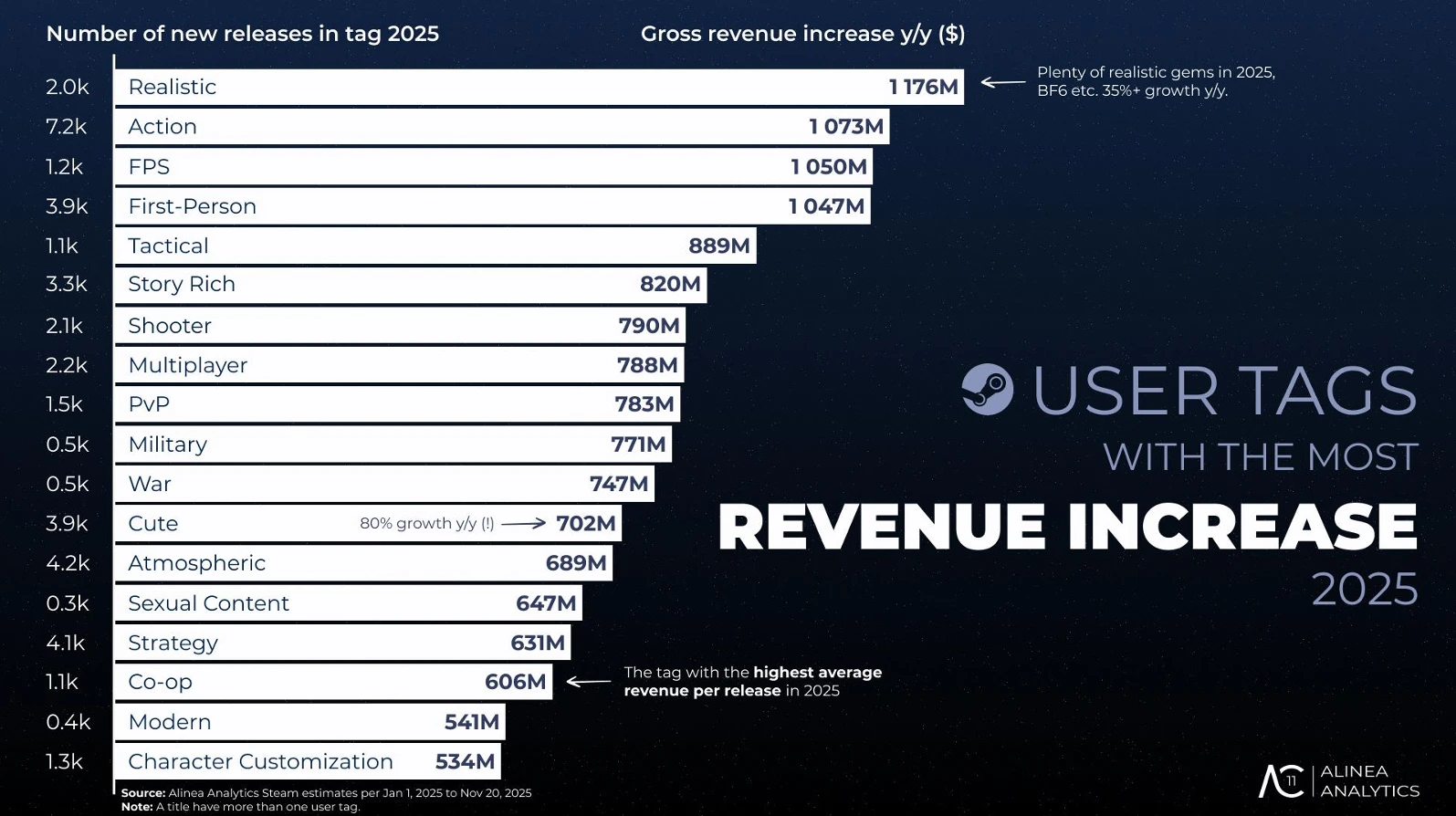
If you want a more granular signal than genres, use the next chart: it shows which Steam user tags had the biggest gross revenue increase year over year in 2025 and how many new releases used each tag. That’s helpful when you’re choosing theme and positioning, not just deciding which of the best selling game genres to follow.
The most popular genres are always tied to iconic titles, which is why developers are in no rush to retire them. These games tend to come back remastered or as remakes. Learn more about the difference between the two from our artcile:
[[ref:the-difference-between-remasters-remakes-reboots-and-ports-in-games]]
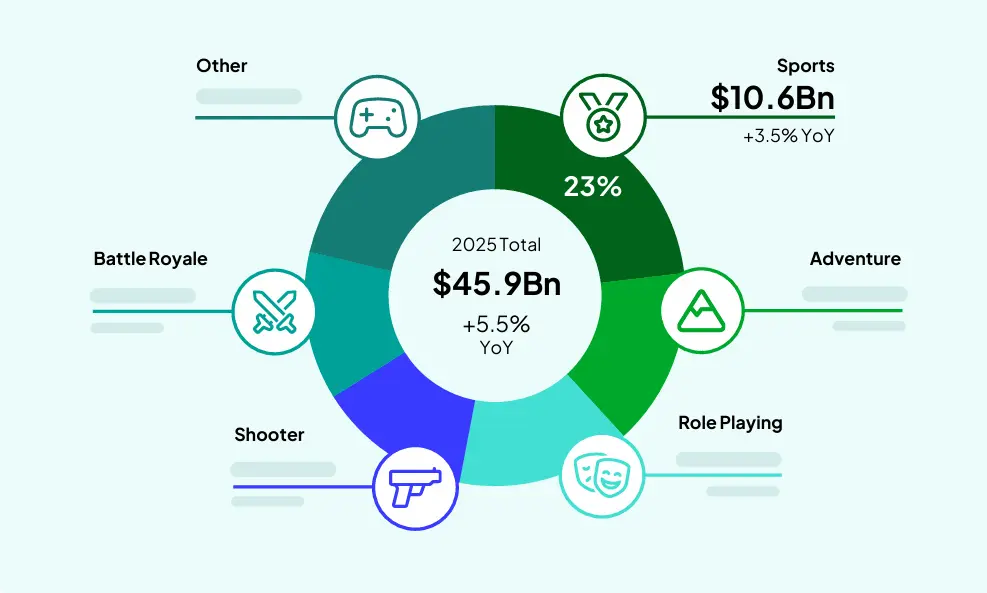
Newzoo’s 2025 revenue split shows console spending led by the familiar cluster of Sports, Adventure, Shooter, Battle Royale and Role Playing games, with total console spending shown at $45.9Bn.
For 2026, the useful nuance is inside the genres. Newzoo’s 2026 PC & Console report points out that in Sports, annual franchises lost share in 2025 and some playtime moved to Rocket League and new releases. So even safe console categories are getting more competitive in attention.
The second console reality check is concentration: reports show that a large share of console revenue goes to the top 20 games, so breaking through is less about picking a big genre and more about execution – visibility, a strong content plan, polish and brand or IP pull.
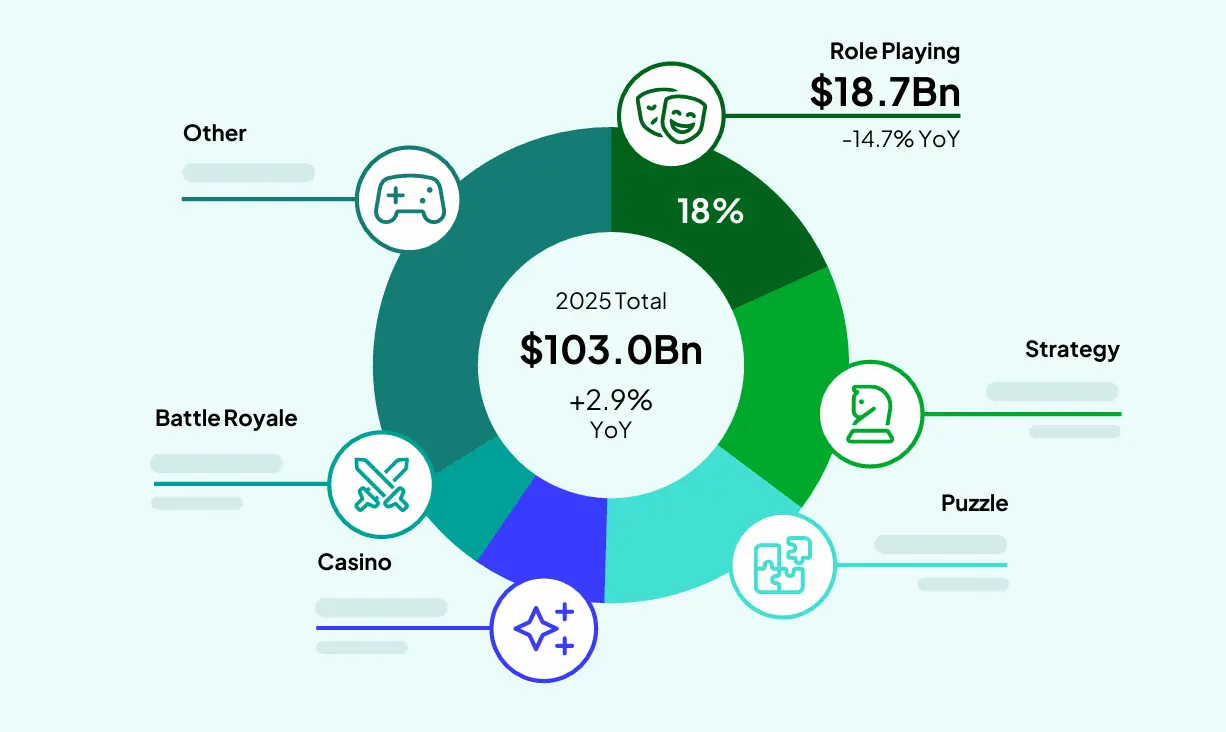
Mobile is still the biggest platform by revenue in Newzoo’s 2025 breakdown at about $103.0Bn. Role Playing is the largest slice at $18.7Bn, but it’s also shown down year on year – a useful reminder for 2026 that the most popular category is not automatically the safest one. Beyond RPG, the top of mobile revenue is spread across several familiar mobile game genres, which means teams compete on execution as much as category fit.
So for 2026 planning, the practical focus is execution: live ops cadence, economy design, and acquisition efficiency. Mobile game genres are a starting point – results depend on how well the team runs the loop, monetization, and retention.
[[cta:Need game art for your next project?:Tell us about your game, and we'll assemble a production-ready art team with a pipeline tailored to your style, platforms and deadlines.]]
Below is our video game genres list for 2026. It’s built for planning across platforms, based on revenue context, shifts in player attention and what each genre typically demands from production.
Shooters are still one of the biggest commercial categories, but the attention side tightened in 2025. Newzoo’s 2026 PC and console data shows shooter and battle royale losing playtime share while sandbox grows, which points to reallocation rather than simple playtime growth.
For developers in 2026, the takeaway is clear: shooter remains among the most popular gaming genres, but outcomes depend on a clear angle inside the category and a retention plan, not the label alone.

Adventure is one of the most reliable popular game genres because it scales well: it can be a small narrative game or a big exploration-heavy world. The core challenge is pacing: the player needs a steady stream of discovery, story beats and interaction, not just a big map.
Newzoo’s 2026 report also highlights a broader pattern: games that keep players invested over time often lean into progression and depth, and adventure tends to benefit from that long-tail behavior.

RPG is a commitment to long-term engagement: builds, progression and content depth. That’s why this most popular video game genre can be expensive to produce, but also powerful when executed well – players stay for systems, not just for the first few hours.
Newzoo’s 2026 report points to a useful planning idea: progression-heavy games tend to hold value over time better than titles that rely only on launch momentum. That’s one reason RPG remains a strong direction when you’re building for longevity.

Strategy games win when they earn time, not when they spike attention. Newzoo’s 2026 report shows PC’s long tail is expanding and that more playtime is shifting beyond the top-20 games.
For Strategy teams, that points to a practical planning bias: build for longevity – readable depth, strong onboarding and a steady cadence of scenarios, modes, or expansions that keep the back-catalog relevant. For developers, strategy is rarely the top game genre by raw reach, but it can be one of the best genres for long-term engagement if the systems are deep, readable and rewarding.

Sports titles are built on licensed expectations: players want the sport to feel authentic, controls to be responsive and the meta loop to keep giving goals beyond a single match. Even when the core rules are fixed, the product still changes every year through modes, progression and live service layers.
Newzoo’s 2026 PC & console report notes that in 2025, annual franchises’ share inside the Sports genre dropped and some playtime shifted toward titles like Rocket League and new releases. That’s a useful reminder for developers: sports isn’t only “annual simulation”, and the space rewards fresh takes when the core loop is strong.

Puzzle games work when the rules are clear and the difficulty curve feels fair. The best puzzle titles make players feel smart quickly, then keep them engaged through variety and pacing.
In Newzoo’s 2025 market report, Puzzle sits among the stronger mobile categories, which is why it remains one of the more reliable top game genres for content-driven products. The practical takeaway for 2026 planning is that puzzle success is usually decided by production rhythm (how quickly you can ship levels), tuning (difficulty and hints) and a lightweight meta that gives people a reason to return.
For a more practical walkthrough of puzzle game production – core loop, level pipeline, difficulty tuning, and meta – see our step-by-step guide on how to make a puzzle game.

Racing games sell a specific feeling: speed, control, and mastery. Whether it’s simulation or arcade, players judge the experience instantly through handling, camera, feedback and presentation.
Newzoo’s 2026 report suggests racing can still be a solid revenue play, even when it isn’t dominating genre conversations. In practice, that means racing games win on polish and replayability — great handling and feedback, supported by events, challenges, and a steady flow of cars and customization.

Fighting games are built around precision and readability. Players stay for mastery: tight inputs, clear animation language and the sense that learning the system makes them better.
From a 2026 planning perspective, fighting behaves differently from the broadest popular video game genres: it is typically smaller by reach, but it can retain a dedicated audience when fundamentals are strong. Newzoo’s 2026 breakdown shows Fighting is present in the long tail on PlayStation, but it’s not one of the genres like RPG and adventure that dominates it. So if you’re building a fighting game, the lever isn’t mass reach — it’s retention: learning tools, match quality and online performance.

Genre choices translate into concrete production work. Different categories demand different asset volume and update cadence, and that affects budget and timelines as much as game design does. A practical way to reduce risk is to decide early what ships at launch, what must be expandable post-launch, and what your team can realistically produce per month.
When game art becomes the bottleneck, RocketBrush Studio can support you with characters, environments, UI and marketing visuals with predictable delivery.


_result.webp)