menu
Close

GET IN TOUCH
Check what other game developers say about working with RocketBrush Studio:

BLOG
Outsourcing art in gamedev is often viewed as a cost-saving measure: why create a whole department when you can use an external team? However, in production reality, delegating art to a vendor is a strategic decision, often motivated by long-term vision.
The benefits include access to a talent pool with a specific skill set, faster production scalability, and the ability to bypass long-term hiring commitments. It also allows studios to focus internal resources on core systems and creative direction, while specialized external teams handle asset production.
In this article, we discuss the issue of how to choose a game art outsourcing studio that would fit your project.
A core principle of choosing a game art outsourcing studio is understanding whether or not an external team fits your production model. Outsourcing is not a default solution — it works best when it solves a specific production constraint or unlocks capabilities your internal team does not have.
Ask the following questions before committing to the idea:
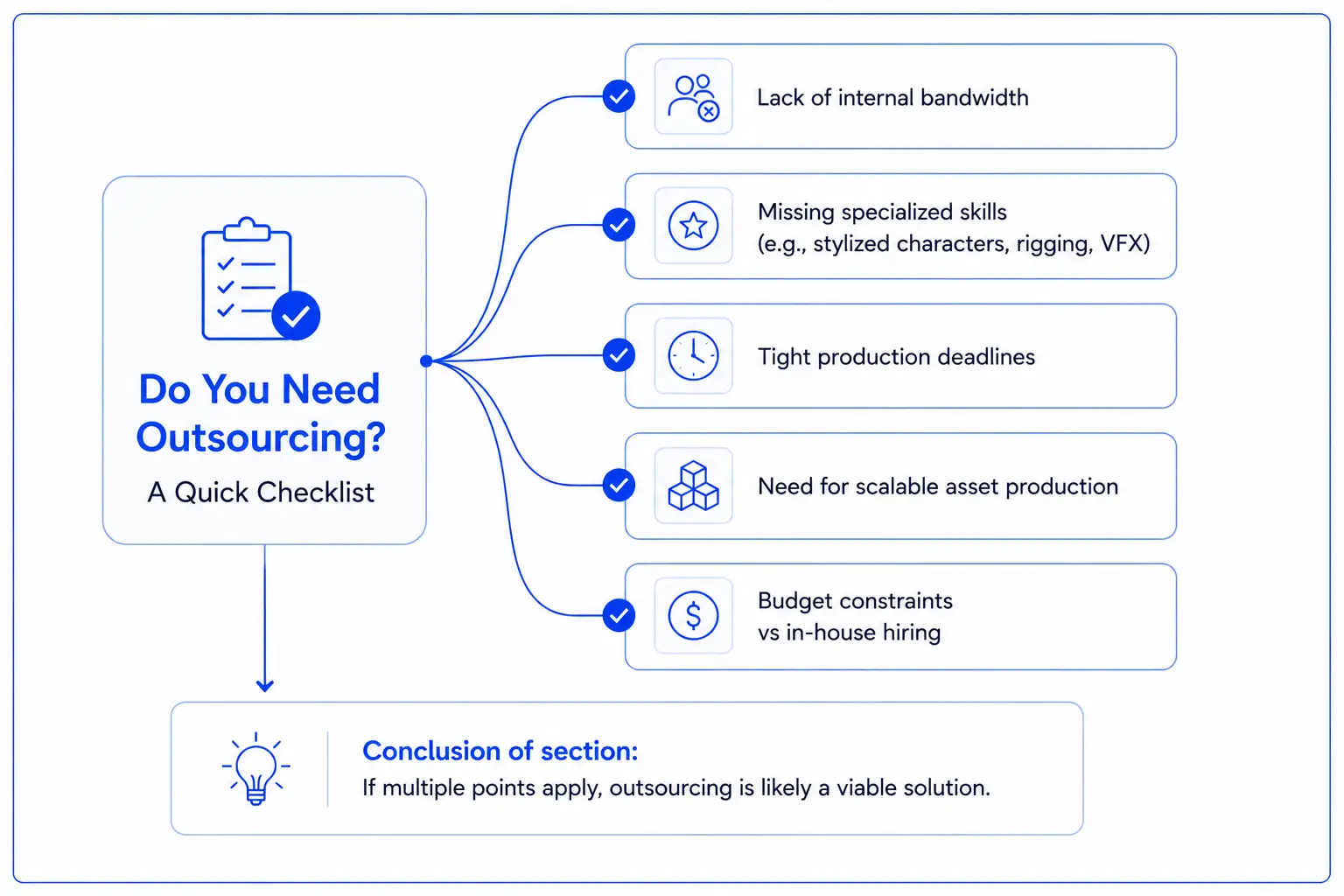
If you are choosing to outsource, it’s important to make sure that you select the right vendor. The goal is not just to find a team that can produce assets, but one that can integrate into your pipeline, understand your constraints, and deliver consistently at the required quality level.
The first and most important step in finding a game art outsourcing studio is considering the scope of work. That would determine whether you need to look for a bigger multiservice studio, a smaller specialized one, or a freelance professional.
For example, a full-cycle production with multiple asset types (characters, environments, UI, animation) may require a studio that can handle cross-disciplinary coordination. In contrast, a single need, such as stylized character concept art or weapon modeling, can often be handled more efficiently by a niche vendor or an individual specialist.
In early pre-production stages, you’ll need to assess which type of art you actually require. This depends on the genre, platform, and visual style of the game. A mobile 2D strategy game, for instance, will prioritize UI/UX and iconography, while a realistic 3D action game will require detailed environments, characters, and animation systems.
Below is a table with the most common categories of game art services:
Before and during communication with the vendor, be specific. “3D art” in general is too broad to outsource effectively — it does not define style, complexity, or technical requirements. A clearer request would sound like “stylized low-poly environment props for mobile” or “realistic PBR weapons with game-ready topology.”
The more precisely you define your needs, the easier it becomes to identify the right vendor and avoid misalignment during production. That level of clarity is what you will be focusing on while choosing a studio.

After defining what type of art you need, the next step is to consider the existing pipeline and define where you want the game art outsourcing studio to fit. This means agreeing on review stages, delivery formats, file structure, and who handles asset integration on the client side.
During collaboration, alignment at the pipeline level will directly affect speed, quality, and iteration cycles.
Misaligned pipelines are one of the most common causes of delays and rework. Even highly skilled vendors will struggle if technical expectations are unclear, so make sure you communicate your expectations early.

An important step toward finding the right studio is building a shortlist of potential partners. The goal at this stage is not to choose a vendor yet, but to understand the landscape and narrow down viable options.
Reliable sources include industry platforms, professional networks, curated directories, and referrals. Peer recommendations and client testimonials are particularly valuable, as they provide insight into real production experience. These channels will surface a range of options, from freelancers to mid-sized teams to large studios, so it’s important to evaluate which type best aligns with your needs.
To make the first round of research easier, the article below compares several studios by services, portfolio focus, and production strengths.
[[ref:top-10-game-art-outsourcing-studios]]
Your production needs determine the size and specialization of the game art outsourcing studio you should look for. Freelancers can be a good fit for focused tasks, but may be harder to integrate into established pipelines. It’s also unlikely that one person could take on creating a game art bible. Smaller and medium-sized studios often provide closer communication and more focused collaboration. Larger vendors can handle broader scopes and scale for complex production needs, but may be less flexible when it comes to process changes, small iterations, or highly customized collaboration.
Here is a table that covers the pros and cons of dealing with different vendors:
There is no universal best option. The right vendor type depends on your scope, timeline, pipeline complexity, and how much production coordination you expect from the external team.
Cost is often one of the reasons teams look beyond their local market. Eastern European game art studios can offer more competitive rates than North American or Western European vendors, while still providing experienced artists, art leads, and project managers.
But the lowest estimate is not always the safest choice. When comparing studios, look at what is included in the price: feedback rounds, source files, technical checks, project management, availability, and production oversight. Time-zone overlap also matters because delayed feedback can quickly slow down iteration.
At RocketBrush Studio, we try to keep this balance practical: competitive rates, dedicated project management, art direction support, and a distributed team that helps keep communication moving across different working hours.
If you are still planning the full outsourcing setup — scope, brief, workflow, revisions, and handoff — the guide below explains how to structure the process before production starts.
[[ref:game-art-outsourcing-complete-guide]]
Reliability, technical fit, and production alignment are the main criteria for choosing a game art outsourcing studio. After you know what size team you are looking for, it’s time to evaluate whether a studio can consistently deliver within your pipeline.
Here is a short list of the things you should review:
At RocketBrush Studio, we don’t just check these boxes, we build production setups around them, combining the right artists, clear workflows, and hands-on direction so your project runs smoothly from first brief to final delivery.
[[cta:Working on a new gaming project?: Share your project details and we’ll match you with a team aligned with your style, engine, and delivery goals.]]
Just as important as identifying strengths is spotting risks early. Many outsourcing issues stem from misalignment that’s visible during evaluation if you know where to look.
A strong vendor is defined by consistency, clarity, and production fit. Evaluating both strengths and warning signs early helps you avoid costly missteps and build a partnership that can scale with your project.
Choosing the right art outsource studio requires an understanding of how to evaluate a vendor. That doesn’t mean art only, on the contrary, many teams fail at matching their requirements with the options available. Below is a game art outsourcing checklist designed specifically for that:
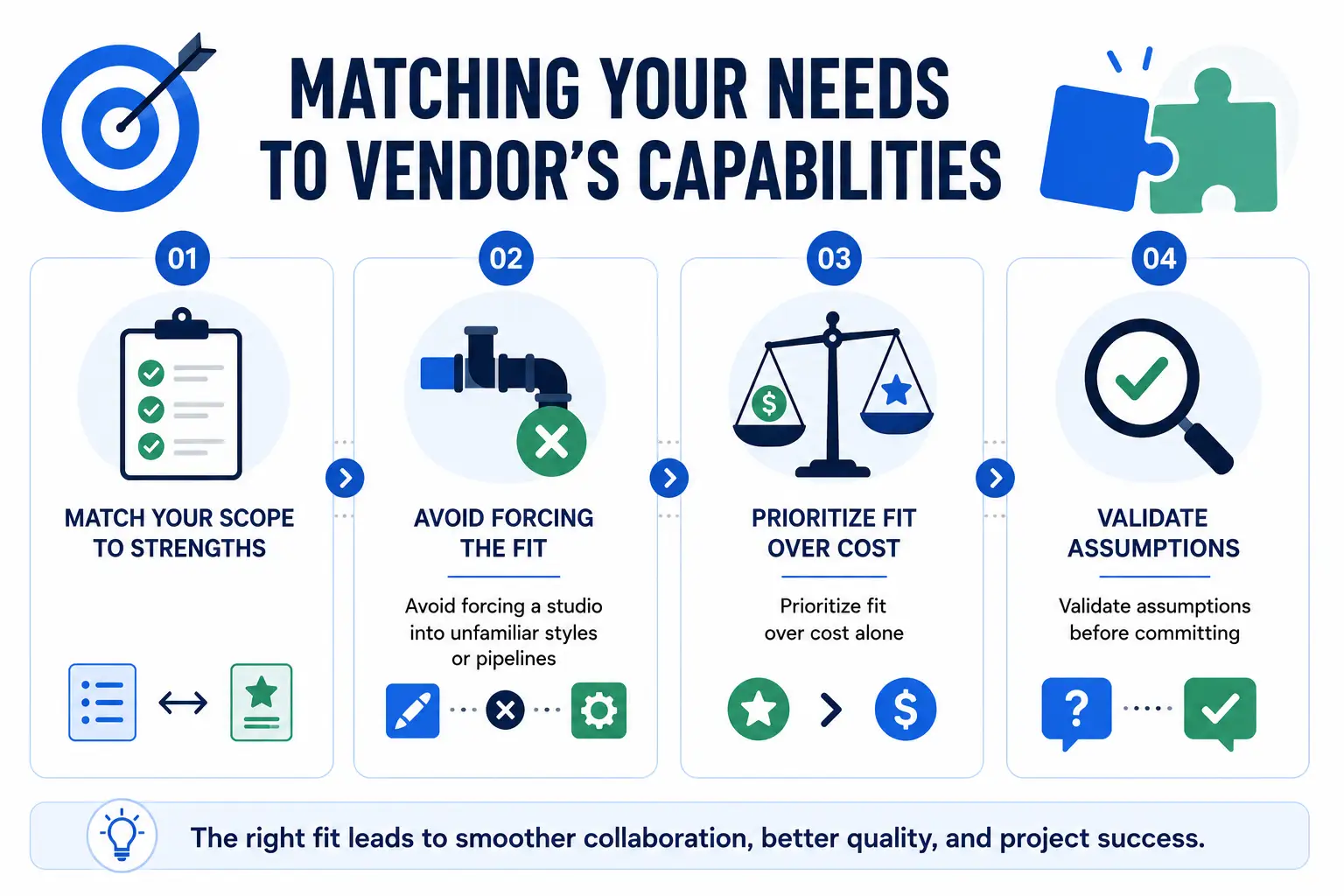
By recognizing the strengths and weaknesses in a potential vendor, you can find the best approach to collaboration.
We started by asking, how to choose a game art studio? And the most obvious answer is always checking a portfolio. But remember, it shows potential, but it’s a test task that proves execution.
In our experience, most collaborations start with a small test task. It helps both sides check quality consistency, communication, technical accuracy, and turnaround time before moving into a larger scope. This is often the stage where clients understand whether the vendor fits their production process — and why many of them return for full-scale or long-term work.
A test has to be designed with consideration of your goals. In other words, create a specific task that would allow the vendor to showcase everything that may be relevant to you later. A poorly designed test gives misleading results.
Your test task should mirror actual work conditions while remaining focused and easy to assess.
A strong test task removes ambiguity and gives both sides a clear framework for evaluation.
Even a well-designed test can fail if it doesn’t reflect real production constraints. These practices help ensure the results are fair, useful, and indicative of long-term collaboration.
A task, well executed on your side, reduces risk and provides a reliable basis for selecting the right partner.
Choosing the right game art outsource studio is a strategic decision that directly impacts production quality, speed, and scalability. The key is to clearly define your needs, evaluate vendors beyond surface-level visuals, and ensure alignment with your pipeline and technical requirements.
A structured selection process — supported by realistic test tasks — reduces risk and helps build long-term, reliable partnerships.